5 Axis CNC Machining Services High Precision Fast Turnaround
What Is 5-Axis CNC Machining?
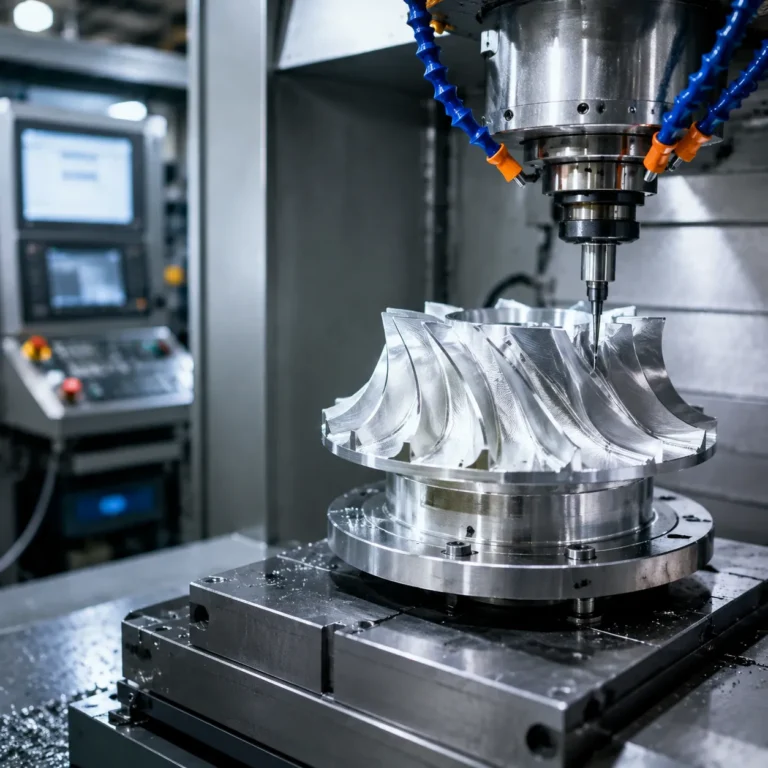
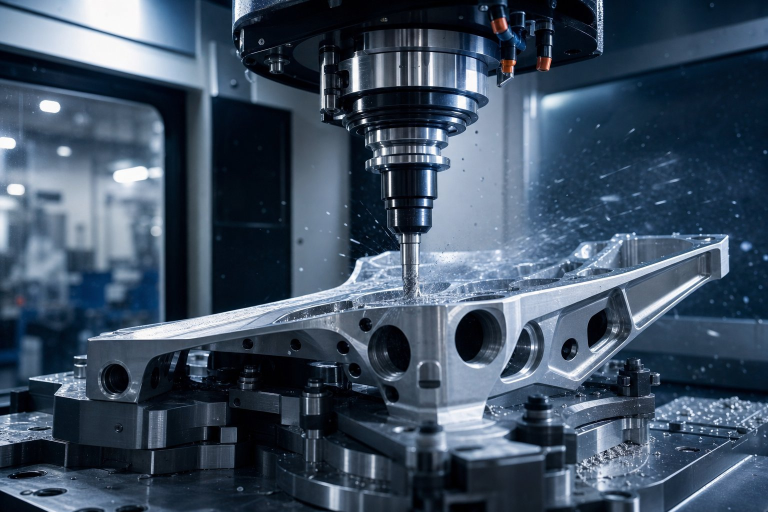
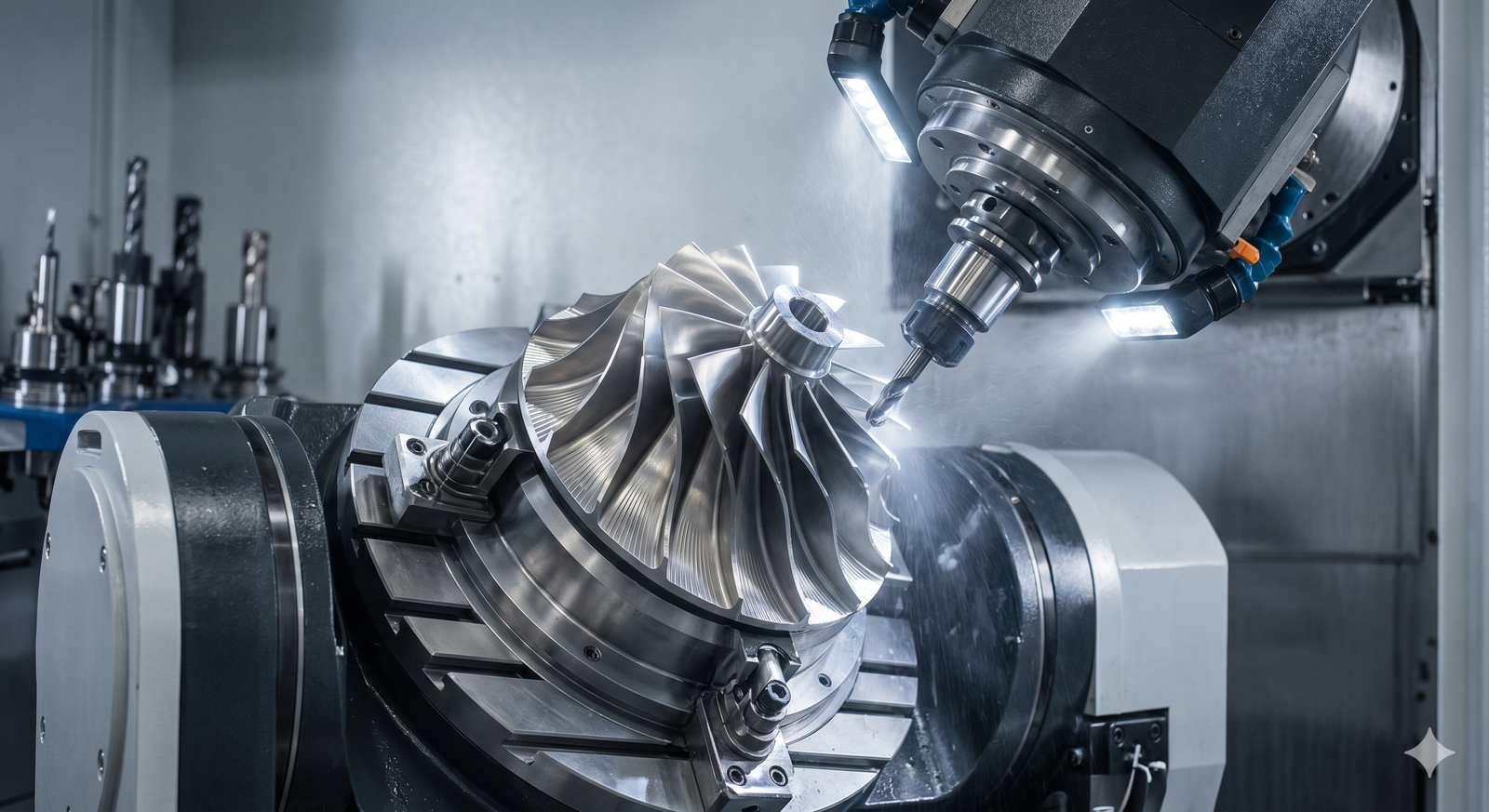
In precision manufacturing, 5-axis CNC machining services represent the pinnacle of subtractive fabrication. Unlike traditional milling, which moves a cutting tool along three linear paths, true multi-axis milling manipulates the workpiece or the cutting head across five distinct directions simultaneously. This advanced capability allows for the fabrication of highly intricate geometries without multiple setups.
Understanding the Kinematics: Linear and Rotational Axes
Standard CNC machining operates on three linear axes (X, Y, and Z). Our advanced 5-axis workstations integrate two additional rotational axes (chosen from A, B, or C), allowing the cutting tool to approach the part from virtually any angle.
| Axis | Type of Movement | Description |
|---|---|---|
| X | Linear | Left-to-right movement |
| Y | Linear | Front-to-back movement |
| Z | Linear | Up-and-down movement |
| A | Rotational | Rotation around the X-axis |
| B | Rotational | Rotation around the Y-axis |
| C | Rotational | Rotation around the Z-axis |
True Simultaneous 5-Axis Cutting vs. 3+2 Positional Cutting
Achieving ultra-precision requires understanding the distinct difference between true simultaneous cutting and indexed 3+2 machining. Both methods utilize five axes, but their execution and capabilities differ significantly.
- Simultaneous 5-Axis Machining: The CNC controller continuously adjusts all five axes at the same time. The tool maintains continuous contact with complex contours, which is essential for machining organic shapes, deep undercuts, and aerodynamic profiles with sub-micron accuracy.
- 3+2 Positional Cutting: Also known as indexed CNC milling, the machine uses the fourth and fifth rotational axes to lock the workpiece into a fixed position. The actual cutting is then executed using only the three linear axes (X, Y, Z).
While 3+2 cutting is effective for flat-faced prismatic parts, true simultaneous 5-axis cutting is the superior choice for handling highly complex geometries and achieving flawless surface finishes in a single operational cycle.
Why Choose 5-Axis CNC Machining Services Over Traditional Methods?
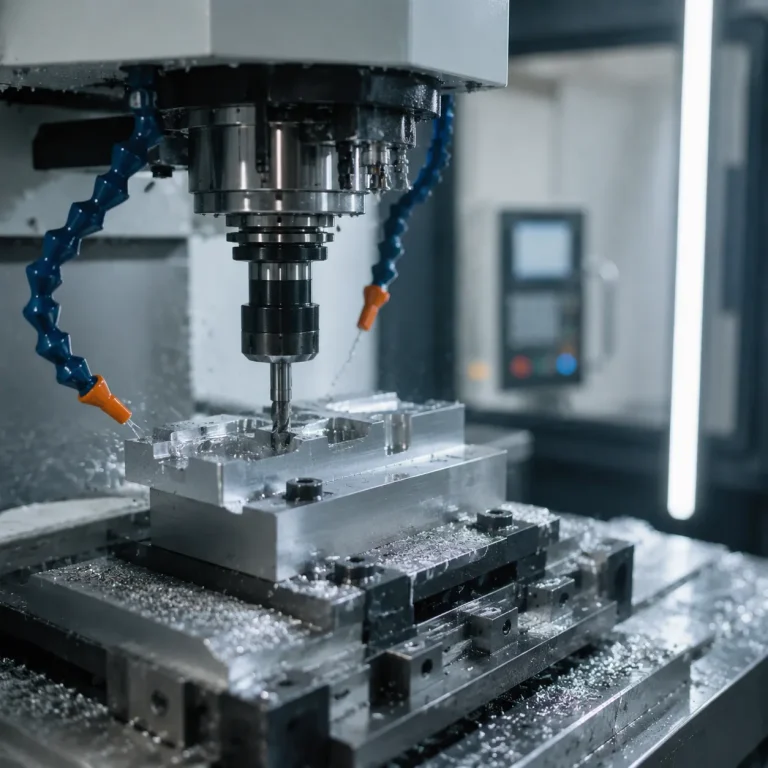
Traditional 3-axis milling often requires flipping and repositioning a part multiple times. Our advanced 5-axis CNC machining services eliminate these extra steps by cutting on five sides of a part simultaneously.
Here is exactly how our multi-axis milling upgrades your production efficiency, accuracy, and lead times.
The Multi-Axis Advantage vs. Traditional Milling
| Feature | Traditional 3-Axis Milling | Our 5-Axis CNC Machining Services |
|---|---|---|
| Part Setups | Multiple manual setups and fixture changes | Single setup for most complex geometries |
| Precision & Tolerances | Lower accuracy due to stacking alignment errors | Ultra-tight tolerances and sub-micron accuracy |
| Lead Times | Longer production cycle times | Drastically reduced delivery schedules |
| Tool Wear | Higher vibration with long, extended tools | Shorter cutting tools for faster, smoother cuts |
Key Benefits for Your Production
- Zero Manual Repositioning: Moving a part by hand between cuts introduces human error. We eliminate multiple setups, ensuring every cut aligns perfectly with the last.
- Sub-Micron Accuracy: Holding tight tolerances is critical for high-stakes industries. By machining complex parts in a single setup, we prevent stacking errors and maintain extreme precision.
- Faster Turnaround Times: Cutting down setup time means we shrink your overall production cycle times. You get your finished parts delivered faster without sacrificing quality.
Key Engineering Advantages of True Multi-Axis Milling
When you transition to true multi-axis milling, you unlock capabilities that standard 3-axis setups simply cannot match. By continuously moving across all axes simultaneously, our 5-axis CNC machining services eliminate the compromises of traditional manufacturing.
Here is how true multi-axis milling upgrades your part quality and production efficiency:
Master Complex Geometries and Undercuts
Traditional milling struggles with deep pockets, complex curves, and intricate undercuts, often requiring specialized, expensive fixtures. True 5-axis simultaneous cutting tilts the part or the tool dynamically, allowing the cutting head to reach tight angles and complex geometries easily in a single setup.
Shorter Cutting Tools, Less Vibration
In 3-axis machining, reaching deep cavities requires long, slender tools that are highly prone to tool vibration and deflection. Because our 5-axis workstations can tilt the workpiece or the spindle closer to the cutting zone, we can use much shorter, more rigid cutting tools.
- Reduced Chatter: Shorter tools maximize rigidity, eliminating tool chatter.
- Higher Precision: Minimal tool deflection guarantees tighter tolerances across deep features.
- Faster Feeds: Rigid tools allow for aggressive, efficient cutting speeds without risking tool breakage.
Mirror-Like Surface Finishes
Maintaining an optimal cutting angle makes a massive difference in your final part quality. Simultaneous multi-axis milling ensures the tool meets the material at the perfect contact point continuously, preventing the tool dragging that mars part surfaces.
| Feature | Standard 3-Axis Milling | True 5-Axis Milling |
|---|---|---|
| Tool Rigidity | Low (Requires long, flexible tools) | High (Uses short, stiff tools) |
| Surface Finish (Ra) | Typical Ra 1.6μm – 3.2μm | Mirror-like Ra 0.4μm to Ra 0.8μm |
| Manual Post-Processing | High (Extensive polishing needed) | Minimal to none |
By achieving an ultra-smooth surface finish straight out of the machine, we drastically reduce the need for manual benchwork, lowering your costs and accelerating your delivery timeline.
Materials Processed in Our 5-Axis CNC Workstations
Choosing the right material is critical for the success of your project. Our advanced 5-axis CNC machining services handle a wide range of materials, from ultra-hard metals to high-performance plastics. By matching the right material with our multi-axis capabilities, we ensure your components meet exact performance and durability standards.
High-Performance Metals
We routinely machine high-strength metals that require maximum precision and stability during the cutting process.
- Aerospace-grade Aluminum (7075): Offers an exceptional strength-to-weight ratio, making it ideal for lightweight structural components.
- Titanium: Known for its extreme strength, corrosion resistance, and biocompatibility, though it demands the rigid setups our workstations provide.
- Stainless Steel: Delivers excellent durability and wear resistance for harsh environments.
- Brass: Provides high conductivity and low friction, perfect for complex electrical and mechanical parts.
Engineering Plastics
For applications requiring lightweight, chemical resistance, or electrical insulation, we machine premium industrial plastics to tight tolerances.
| Material | Key Properties | Common Applications |
|---|---|---|
| PEEK | High thermal stability, biocompatible, chemical resistant | Medical implants, aerospace seals |
| POM (Acetal) | High stiffness, low friction, excellent dimensional stability | Gears, bearings, precision wear components |
| Nylon | High impact resistance, strong wear characteristics | Bushings, rollers, structural housings |
| Polycarbonate | Optically clear, high impact strength, durable | Protective covers, medical housings, lenses |
Industries Relying on Precision 5-Axis CNC Parts
We deliver high-tolerance components across sectors where failure is not an option. Our 5-axis CNC machining services provide the exactness, speed, and material integrity required by these demanding global industries:
Aerospace & Defense
Weight reduction and structural integrity are critical for flight-ready components. We machine complex aerospace components from solid blocks of titanium and high-grade aluminum.
Key Parts: Complex turbine blades, impellers, and structural airframes.
The Advantage: Achieving tight tolerances on sweeping, aerodynamic curves with zero manual repositioning.
Medical Devices
Medical components demand absolute biocompatibility and flawless surface finishes to ensure patient safety and regulatory compliance.
Key Parts: Orthopedic implants, spinal screws, and anatomical joint models.
The Advantage: Ultra-precision multi-axis milling of highly intricate, organic geometries in PEEK and titanium.
Automotive R&D & Robotics
Fast-paced engineering environments require rapid iteration and rugged, lightweight end-use parts.
Key Parts: High-load robotic joints, custom manifolds, and transmission housings.
The Advantage: Drastically reduced production cycle times for low-volume production and functional prototypes.
Energy & Marine
Equipment operating in these sectors must withstand extreme pressures, high temperatures, and highly corrosive environments.
Key Parts: High-strength impellers, turbine wheels, and valve components.
The Advantage: Superior mechanical durability and flawless part uniformity achieved via continuous multi-axis milling.
Choosing the Right 5-Axis CNC Machining Services Partner
Outsourcing your most complex projects requires more than just finding a shop with the right machinery. To get the full value of multi-axis milling, you need a manufacturing partner that can handle extreme precision without breaking a sweat.
Here is what we bring to the table to ensure your project’s success:
Advanced Machine Control & Stability
- Dynamic Axis Synchronization: True simultaneous 5-axis cutting requires perfect harmony between the linear and rotational axes. Our workstations utilize advanced CNC controllers to prevent tool dwell marks and ensure smooth transitions.
- Thermal Stability Control: High-speed machining generates heat, which can warp metals and ruin tight tolerances. Our climate-controlled facilities and liquid-cooled spindles eliminate thermal expansion, locking in sub-micron accuracy from the first part to the last.
Digital Twin & DFM Support
Before a single piece of metal is cut, we optimize the entire workflow digitally to save you time and money.
| Feature | What It Means for You |
|---|---|
| Design for Manufacturing (DFM) | We analyze your CAD models early to eliminate deep undercuts, reduce tool vibration, and optimize geometries for faster production cycle times. |
| Digital Twin Technology | We run full software simulations of the entire machining process. This guarantees zero machine collisions, perfect tool paths, and flawless execution. |
Uncompromising Quality Assurance
We don’t just promise precision manufacturing; we prove it with data.
- ISO 9001:2015 Certified: Our entire facility operates under strict international quality management standards to ensure consistency across low-volume production runs and rapid prototyping alike.
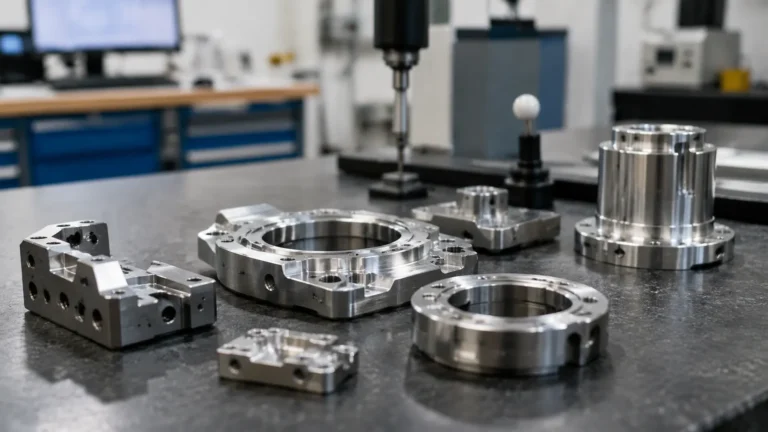
- CMM Inspection Systems: Every finished component undergoes rigorous validation on our automated Coordinate Measuring Machines (CMM) to verify that the final surface finishes and dimensions match your exact blueprints.
5-Axis CNC Machining Services: FAQs
When should I choose 5-axis machining instead of 3-axis milling?
You should upgrade to 5-axis CNC machining services when your part has complex geometries, deep undercuts, or requires machining on multiple faces. While 3-axis vertical CNC milling is great for flat parts, 5-axis cutting eliminates the need for multiple manual setups, saving you time and keeping tight tolerances intact.
What is the maximum part size capability for true simultaneous 5-axis cutting?
Our current workstations handle a wide range of part sizes. The exact limits depend on the specific machine envelope and part geometry:
| Machine Setup | Maximum Part Dimensions | Ideal Applications |
|---|---|---|
| Compact Multi-Axis Milling | Up to 300 mm x 300 mm x 300 mm | Medical implants, small robotic joints |
| Large Simultaneous 5-Axis | Up to 650 mm x 500 mm x 400 mm | Aerospace components, custom manifolds |
How do multi-axis setups lower the overall production cost per part?
It comes down to efficiency. Traditional methods require a machinist to manually reposition the part for every new angle, which introduces human error and drives up labor costs. Simultaneous 5-axis cutting processes almost every side of the part in a single setup. This drastically cuts down production cycle times, eliminates expensive fixtures, and lowers the total cost per part for both rapid prototyping and low-volume production.
What surface finishes are available after 5-axis machining?
Because we use shorter cutting tools that minimize tool vibration, our machines achieve an exceptional “as-machined” surface finish right out of the workstation.
- As-Machined: Ultra-precision finishes ranging from Ra 0.4µm to Ra 0.8µm.
- Post-Processing Options: Bead blasting, anodizing (Type II & Type III), chemical film, powder coating, and mirror polishing.